Equipment Comments
Page 2

| |
| HOME |
| About Tenaya |
| About Us |
| Latest Update |
| Logs from Current Year |
| Logs from Previous Years |
| Katie's View |
| Route Map |
| Links |
| Contact Us |
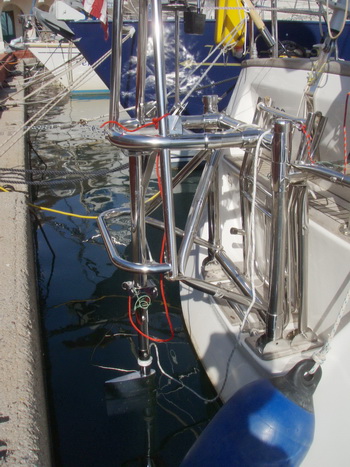
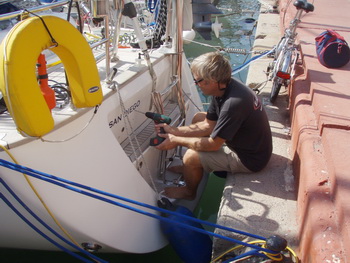
We purchased our Monitor from Scanmar in California and had it shipped to Spain by FedEx. We installed it in Almerimar before leaving for the Canary Islands (September 2008).
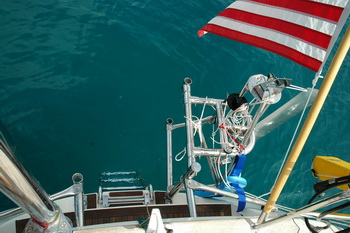
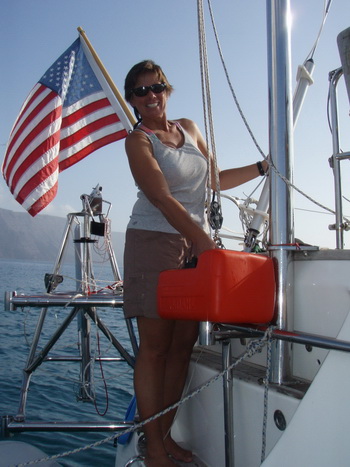
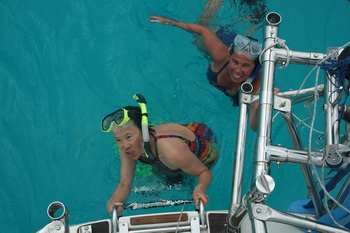
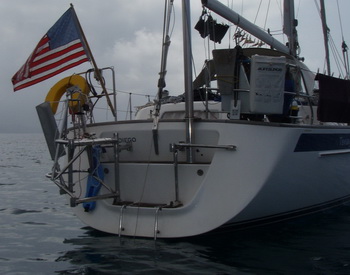
We choose the optional Swing Gate which allows the Monitor to be moved out of the way of the steps. We use the steps a lot for swimming and for getting into and out of the dingy so decided this addition was worth the money. The total cost for the Monitor and Swing Gate was about $7000 (without the Swing Gate it would have been about $4700). Freight to Spain was about $500. We also ended by paying additional tax and duty in Spain even though we should have been able to avoid this as a "Yacht in Transit". It is possible to climb out of the water with the Swing Gate closed using it like a jungle gym.
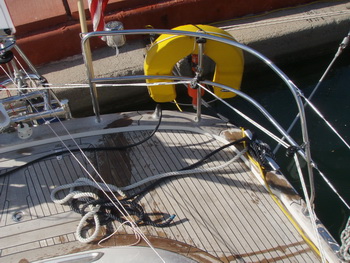
To understand how a wind vane works read about the Servopendulum principle on the Scanmar website or here. The windvane is connected to the steering wheel by a pair of lines that follow our pushpit.
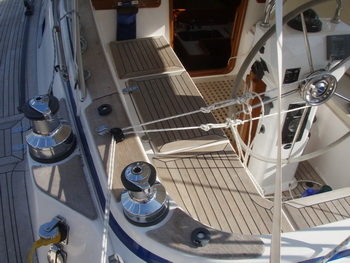
The final block that directs the steering lines to the wheel is attached to a bracket made for attaching safety harnesses. This way, when we are not using the windvane we can remove the block and have a fairly flat area again. This seems to work perfectly.
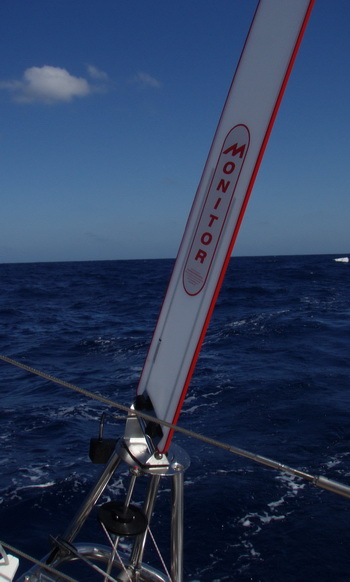
We are 100% satisfied with the Monitor windvane after our first 500 miles of use (Gibraltar to the Canary Islands).
We are still satisfied after crossing the Atlantic and now planning to cross the Pacific.
Would not have wanted to cross the Pacific without it! The best piece of kit on the boat, by far!
Read about the installation of our Monitor Windvane in September 2008
Visit the Scanmar Windvane site
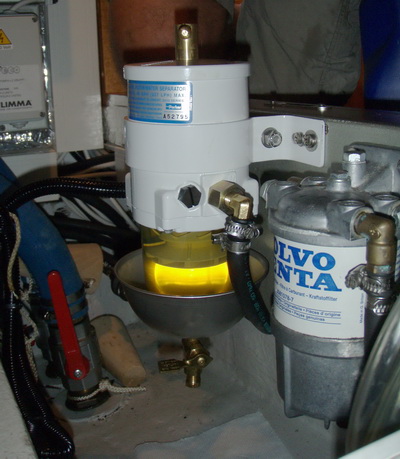
Diesel engines work great for many years and require little maintenance but the fuel needs to be clean and free of any water. Tenaya came equipped with Volvo Penta fuel filters (the filter on the right is for the generator) but without a see-thru section the only way to check if water is in the fuel is to open the filter case. Racor fuel filters are the state of the art with many features including a see-thru bowl and easy drain. They are not cheap ($300 in the USA) but Katie purchased one on her last trip to the USA and after a couple of Fedex shipments to the Canary Islands I had the fittings and installed the filter on November 21, 2008 in Tenerife.
2012 - I added a Racor fuel filter for the generator.
Tenaya came with 6 Tudor batteries enclosed in a custom built box. Each battery is 6 volts, so two batteries are wired in series to give 12 volts and then the 3 sets of two are wired in parallel. Each 2 batteries supplies 225 amps, so our service batteries supply 675 amps. Even when sailing 24 hours a day, with chart plotter and radar on (and the refrigerator) this seems adequate.
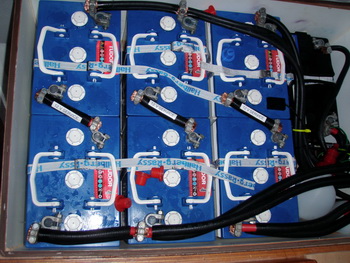
After nearly 4 years of use the batteries are doing fine, but tests of Specific Gravity showed them in the "yellow". They would probably be fine for another 6 months, but in December 2009 we are in St. Maarten, the Caribbean. This is a duty free port and also has one of the largest marine stores in the Caribbean. We made the decision to replace them with new batteries just because it would be easy here, they are in stock and probably the best price ($155 each) we will find for some time.
I decided to replace them with Trojan T-105 6 volt Golf-cart batteries for a few reasons. First, and very important, they are the exact same size, so I didn't have to modify the battery box. Second, one of the people I respect the most regarding today's equipment is Evan Starzinger (Beth and Evan website). He researched different options and choose the T-105 and after a few years is still happy with that choice. Trojan does make a T-125 that is the same size with a little more power. This would have been a good choice, but was not available anywhere I checked in the Caribbean.
We did have the choice of switching to Gel or AGM batteries (the choice of John Neal, the other person whose opinion I trust). But I take good care of our batteries, keeping them charged, checking the water levels, etc. so have a wet-cell battery is a good choice, giving a longer cycle life at lower cost. Nigel Calder, in his book that every boat should have on board, Boatowner's Mechanical and Electrical Manual, he says, "In terms of amp-hours per dollar in cycling applications, in some applications (notably for the liveaboard cruiser), they (Golf-cart batteries) may well be the best value for the money of any battery on the market."
One of the problems is the connections. The Tudor batteries had the standard battery type post and all the wiring was made for those posts. The Trojan batteries that are available in the Caribbean have bolt connections. This required that all the lug fittings be changed to fittings to fit the threaded post. I guess I could have purchased a lug tool (about $75 at the local NAPA store) and bought the fittings (around $50) and then installed them, soldered them myself. But instead we had a great local guy come out to Tenaya and do it for $230..
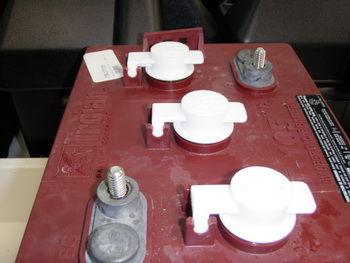
Trojan T-105 with threaded posts
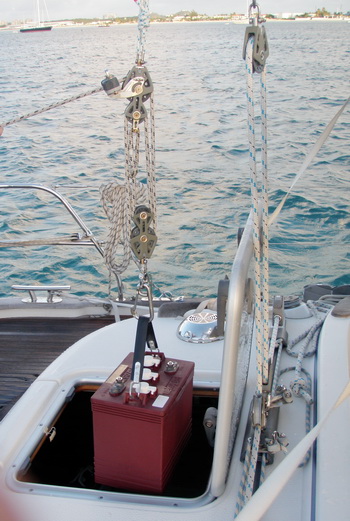
Each battery weighs 30 kg (66 pounds). Using the setup we have for lifting the outboard motor and moving it to the end of the boom made moving batteries up and down easy.
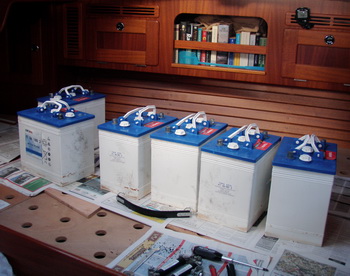
Out with the old and in with the new
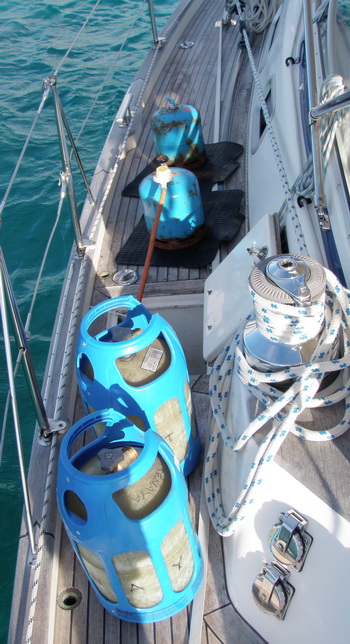
When we ordered Tenaya in 2005 our plan was to cruise Europe and the Mediterranean for a few years. For Europe the best fuel for cooking is Camping Gaz. The blue tanks of Butane are exchangeable everywhere for a reasonable fee, making it easy to get new fuel. But in the Caribbean and as we go further west it is almost impossible to get Camping Gaz, so one of our projects for December 2009 in St. Maarten was to switch to Propane. We bought new lightweight fiberglass propane tanks ($150 each), each holding 10 pounds of propane. The only installation issue was the brackets to hold the tanks. We had new ones made at local machine shop for $200.
In 2013 our fiberglass propane tanks were recalled. We were in Australia and the only options that fit in our locker were made of stainless steel so we bought two at $500 Australian dollars each. Gulp. A welder made the old brackets fit.
Now in 2016 we are back in the Med and have a Camping Gaz bottle laying across the top of the unused stainless tanks.
Some anchorages with fairly deep water close to shore or wind that changes direction during the night need special anchoring. Often the best way to anchor is to drop the anchor aways from shore and then back in, running one or two lines to tie to shore. When the anchor is set and these lines tightened the boat is secure and moves very little when the winds shift. Until now (December 2009) we had tied a couple of lines together, but while we were in the USA we bought a full roll (600 feet) of 12mm multiplait rope from West Marine. We divided it into 2 lines of 300 feet each and store them in mesh bags. These lengths should work wherever we end up anchoring in the future and will work for our transit of the Panama Canal.
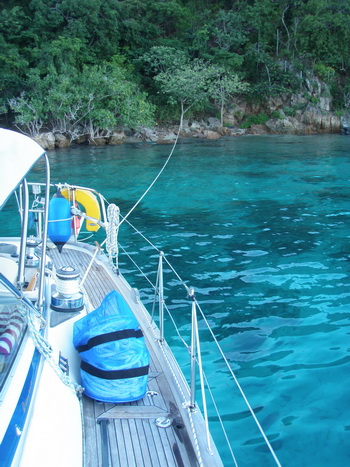
We run the shore line through the stern cleat to the winch, making it easy to tighten the line.
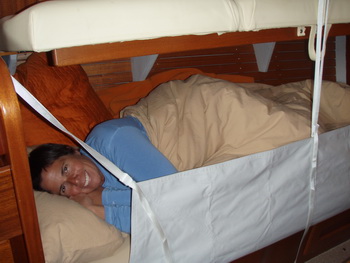
Sleeping while sailing requires something to keep you from falling to the floor. We have Lee Cloths for the main cabin, but since our overnight sailing has always only been the two of us, having one bunk has been fine.
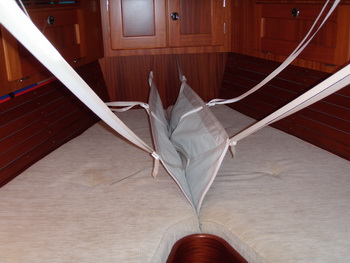
In 2010 we will be joined by another person for our Pacific Ocean crossing, giving the two of us more time to sleep (Fantastic!) and maybe even time to see each other (even better!). So we added lee cloths to the V-Berth in the front cabin.
We did not order any fans installed when we originally ordered Tenaya. After a few years of use and then a year in the Caribbean we have added 2 to the aft cabin and one to the forward V-Berth.
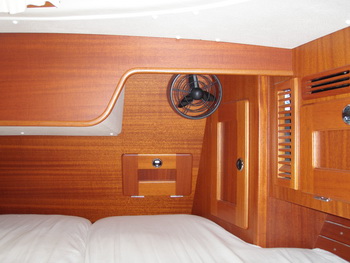
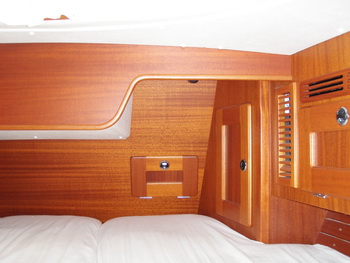
The fans are mounted so they blow right where we are sleeping, but can fold up out of site other times.
Every diesel engine that uses water for cooling has a raw water pump and inside a rubber impeller. This impellers need to be replaced a recommended intervals. I know this....but our generator is behind the engine and not that easy to get to. I do change the oil but was about 150 hours past the time to change the impeller. Just when we thought all our projects were completed in St. Maarten (Dec. 2009) and we could start sailing south the generator overheated. There was plenty of coolant so I took off the cover plate to check the impeller. It was destroyed.
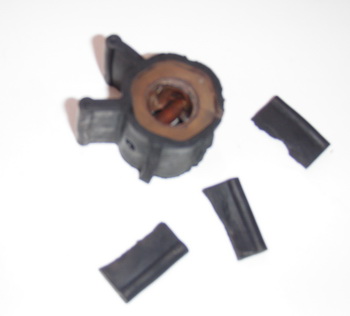
Worse, when I counted the missing pieces there were 3, but there should have been 4. One had been sucked into the water pipe. It could have been worse if it went into the engine. So, what would have been a fairly quick job if I did it in time turned into a bigger job getting the missing piece out of the pipe. I think I will change then on time in the future!
Selden In-Mast Electric Furling
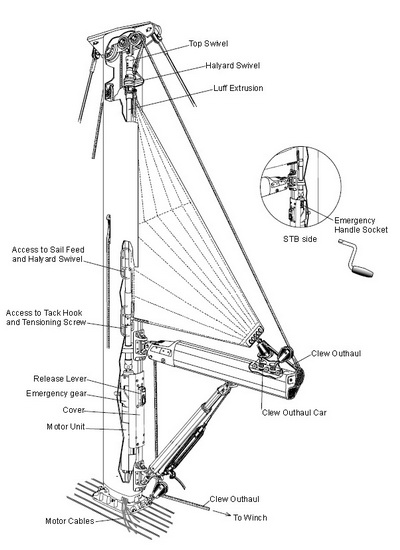
When we ordered Tenaya one of the choices we made was to have electric in-mast furling instead of the traditional style mainsail with slab reefing. I did worry that in-mast furling could be a big issue if the sail jammed. It could be difficult to free at sea, requiring ascending the mast. Even then it could remain stuck.
Two points persuded us to go with the electric in-mast furling. First, Selden's reputation for generally trouble free in-mast furling with masts designed specifically for the purpose. Secondly, and most importantly, the sail could be reefed and opened up again easily and quickly by one person. Perfect for two people on a long passage! That makes the decision to reef early simple.
We are very careful when reefing, making sure the backstay is not tightened too much. There must not be too much bend in the mast and the boom must meet it at a right angle so the boom can't be too high. We have had a couple of jams but caught them in time.
Our worst problem happened in Fiji just as we were leaving on a 1200 mile passage to New Zealand. The electric motor stopped working, making only a humming sound. Replacing the motor would be expensive, maybe impossible in Fiji. We decided to continue to New Zealand using the emergency handle. The emergency handle is fine for rolling in the sail though it requires much more work. But there is no stop for letting the sail out - it all comes whipping out with wind pressure until the gear is jammed by turning the handle. This made reefing much harder so we left a couple of reefs in the main and sailed to New Zealand like that. It took 12 days.
Fearing the worse, we were happy it was only a corroded wire. But taking the motor out and reinstalling it was a major project which took hours. Paul from Northland Spar and Rigging in Opua, New Zealand was very helpful.
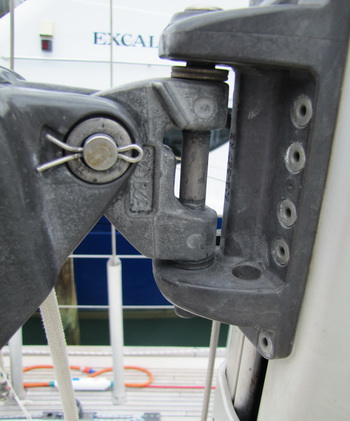
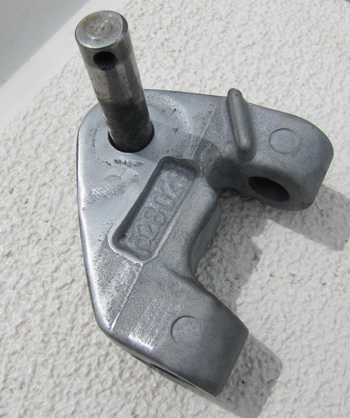
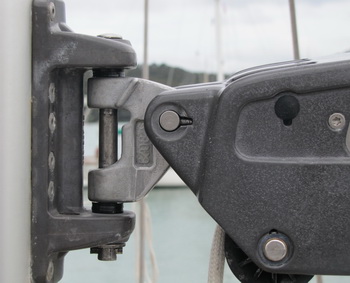
While sailing downwind with decent sized swells, the boom seemed to bang around more than necessary. It bounced up and down as well as side to side. Often we ran a line from the kicker rod attachment at the boom to the midships cleat to hold it tight as possible. When a rigger went over Tenaya he thought there was too much play. He said Seldon is notorious for making things a bit loose and suggested the gap between the pin and hole be lessened.
In Opua, New Zealand we had it modified. The first picture is the original set up. You can't see the gap between the pin and holes of the fitting but you can see the slop between the washers. The middle picture shows the piece after they added more metal to make the hole in the fitting smaller. Now it is slightly larger than the pin. When we reassembled the gooseneck I replaced the metal washers with enough nylon washers to completely fill the space. This should make a much more secure connection with much less slop.
The rigger also mentioned that our spreaders were a little loose - another thing Seldon is known for....Sloppy Seldon. We will keep an eye on them.
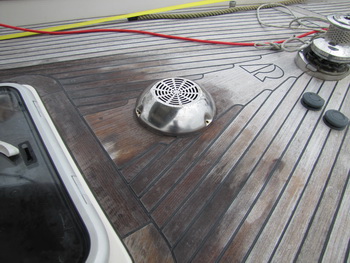
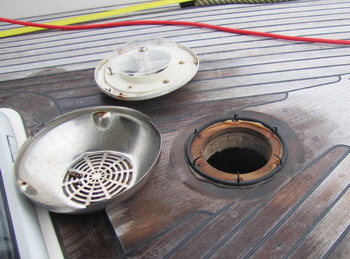
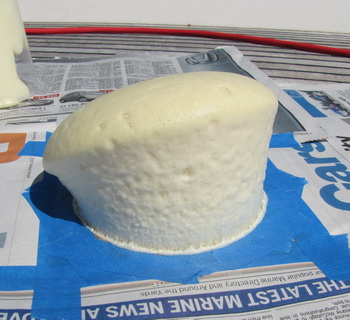
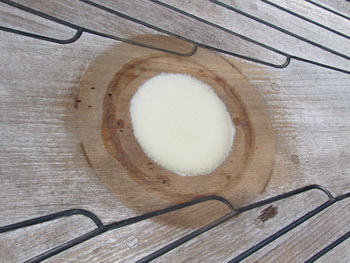
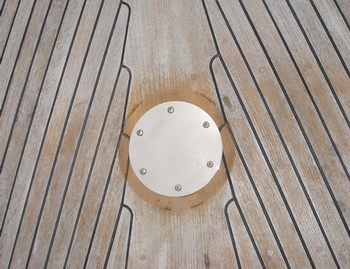
We are still very happy with our decision to buy a Hallberg-Rassy boat. There is almost nothing that we wish was different EXCEPT this stupid vent on the front deck. Each time we have a long sail into the wind and waves, with water pouring over the bow, we have had leakage into the v-berth. After our first problems in the North Sea I tried to seal the vent with tape and silicone. After the crossing from Fiji to New Zealand, where we had waves over the bow much of the 1200 miles, everything was again wet in the forward cabin. The cushions were soaked, things in the lockers below were wet and many books in a hanging locker were ruined. So, high on my New Zealand project list, was to finally solve this problem.
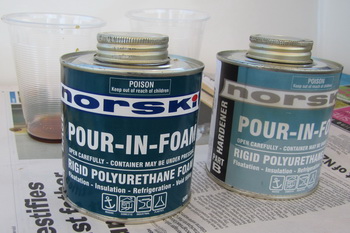
I removed the old vent, fiberglassed the inside with a few layers of glass cloth, filled the hole with polyurethane foam, and had a stainless steel cover made. I hope this solves the problem forever! I would also prefer that Hallberg-Rassy stuck with the originally designed HR40 deck and did not have the where it is under water so often.
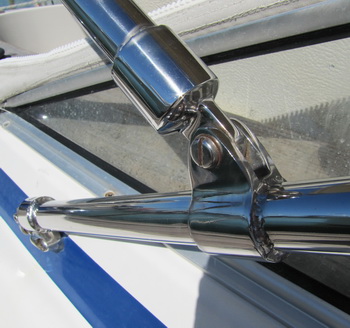
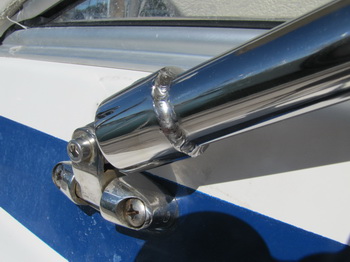
The fitting on the bimini frame get a lot of use, both in setting it up and down and being set up in higher winds. After trying to keep all the set screws tight and still having a problem I decided to have them all welded. The frame never needs to be taken apart, so I think this solves the problem. It also looks better and will not have the discoloration coming from the insides of the connections.
Yanmar Engine Coolant Shut-offs
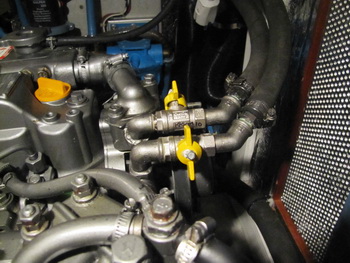
The coolant in the engine is also used to heat the water in our hot water tank. The coolant flows from the engine, thru coils in the water tank and back to the engine. This works great and after motoring for awhile we have nice hot water. But if there were ever a leak in the hot water tank or in the hoses connecting it to the engine all the coolant would quickly flow out and the engine would overheat, possibly damaging it.
In Opua, New Zealand we installed a valve on each hose. Now, when we do not need hot water these can be left in the off position.
Go to Equipment Comments Page 3
Go back to Equipment Comments Page One
.
.